First Published: 14 May, 2026
Lessons from the May 2026 Wellington Brainy Breakfast
At the May 2026 Brainy Breakfast in Wellington, the Marketing Association explored how AI is reshaping discoverability.
Our guest speakers, Matt Bale (Senior AI Advisor, Together and Co-Founder, MBM) and Serge van Dam (KiwiSaas Community Advisory Council Member), two highly successful entrepreneurs in their respective fields, showed us just what the machines are capable of now, what the future can hold and how to leverage the new wave of AI smarts.
Matt Bale: When AI filters the market
Rightfully earning the label of thought leader, Matt started by cautioning us that things were about to get uncomfortable. A period of transition. There is a BIG SHIFT in the Search, discovery and consideration journey. The shift is now about algorithmic availability, where AI agents are the gatekeeper.
From attention to algorithmic eligibility
Looking back over 50 years, marketing has been about competing for attention. Are our brands and messages remembered? We were chasing mental availability. Now, we are coming out of the Programmatic era, where digital was focused on optimising the options and machine learning decided which impressions to buy. We focused on digital ranking for marketing, discovery, attention, search & display. To make this work, we had to compress everything - operate fast - strategy became signals. Decisions become data.
Now, in the Agentic era AI is deciding HOW the campaign should run. These systems aren’t asking who is bidding the most, they’re asking who is the most persuasive?
Matt hypothesised this decade coming will be about competing for Inclusion (as well as attention).The shift to AI and Agentic AI is the dawning of a new era. The machines are asking, can I trust this enough? We are moving from Ranking to Inclusion
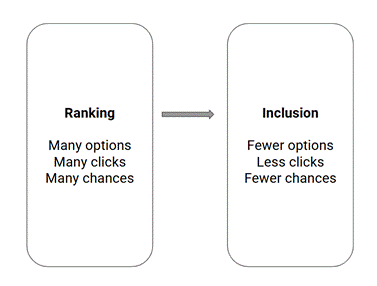
Giving our brains some serious reframing work to do, Matt introduced the Dual Layer Trust Model.
Memory and emotions remain important to marketers as we’re human. Creativity will continue to create human demand, but systems will impact fulfillment. It’s not and/or, it’s now and/and.
As Matt put it: “If your message doesn’t show up, it’s not a creative problem, it’s an infrastructure problem.”
Your brand no longer competes only for attention. It competes for interpretation. If machines do not understand you, they cannot recommend you.
That means brands need to give machines clearer instructions through four things:
You cannot simply campaign your way into a machine’s mind.
Losing before the click exists
The commercial implication of this change is sobering. If a business generates $10m in profit, and 70% of demand is driven by search, then $7m is tied to search visibility. If even half of that demand becomes AI-mediated, that means fewer clicks, fewer customer journeys, and a clear shift in revenue risk.
Search still matters because it captures intent. AI is changing the point of choice. Search still matters because it captures intent, but AI answering services are starting to shape what happens before the click. They collapse choice, reduce second chances, and create a “winner takes most” environment where brands can lose before a customer ever reaches their website.
This is especially relevant in low-emotion, high-inertia categories like energy retailing, where customers are likely to accept a credible recommendation rather than compare every option themselves. If AI becomes the filter, then being absent from the answer means being absent from the market in that moment. Or, as Matt put it: “If you’re not the answer, you’re not in the market in the moment.”
For marketing, this creates a shift from campaigns to systems, from messages to meaning, and from channels to surfaces. The question is no longer just, “What are we saying to customers?” It is, “What can AI systems understand, infer and trust about us?”
Before optimisation comes eligibility. Brands need to be visible, understandable and credible across the surfaces AI systems learn from: websites, product feeds, reviews, third-party mentions, structured machine readable content, comparison content and public information.
The new reality is that brands are competing to be chosen by both humans AND machines. That means AI visibility cannot be treated as a one-off fix. It needs always-on tracking, structured clarity, stronger trust signals and a clear playbook for staying present in the answers that shape demand. Matt helped us unpack that.
What does clear structure look like?
What does this mean for marketing?
This creates a practical shift in how marketers need to think:
“And if you don’t already truly know how you’re showing up in AI Answer platforms that filter the human market, you’re already behind.”
As the crowd absorbed the inference of Matt’s observations and started to consider the application in each of their roles, he offered some sage advice
“Build your learning really fast. It’s not a sprint or marathon, it’s now a decathlon.”
By this point, Matt was building to a crescendo and our minds were swimming somewhere in the sea of the future. He went on to make it very clear. Mistakes now, could impact big later.
Four simple mistakes that can come at a real cost:
1. Waiting until competitors own the space, first movers win, it will be harder later…
2. Optimising content in isolation from structure.
3. Abandoning traditional SEO…SEO is still vital, and the search sector is still mission-critical; don’t lose your focus on this right now.
4. And lastly, flying blind without measurement & visibility in the new AI-filtered era.
So, when Matt wrapped with a simple “Good luck”, it felt less like a throwaway line and more like an appropriate mic drop. Because if AI becomes the filter between human intent and brand choice or behaviour change, marketing needs to understand not only how people find us, but how machines decide whether we deserve to be found.
Serge van Dam: Agentic AI in the real world
Where Matt gave us the strategic lens, Serge gave us the live wiring: what this looks like when businesses start putting Agentic AI to work across real marketing and sales processes.
If our brains weren’t already processing deeply and at pace, Serge van Dam picked up the thread with perfect timing. He hit the room with the kind of pace and energy that stopped this writer in her boots. A fast-moving tech entrepreneur, he had the room on their toes and proceeded to inspire us to learn a different AI dance as he unpacked what AI makes possible.
Before we go deep, I share my simple summary: AI can help smart people build highly informed businesses in a fraction of the time.
Starting with a seriously high word count slide of a marketing framework entitled 3.0 Market and Sell Products and Services - a process classification framework, he quickly contrasted flicking to the next slide to demonstrate how much simpler it can be if you use AI as “Bottom Up technology - adopting AI organisationally” asking the room to think bold.
Serge’s AI Execution Framework.

Focusing on the marketing lens - and giving a prime example of direct marketing not using any data and not personalising and marketing falling flat. If marketers do nothing else - use AI to support your efforts around Lead Enrichment and Automation. Like seriously, ask the agents to unpack your data, enrich your leads and automate your messaging. Hell, it can even estimate your returns which is a great way of keeping your CFO happy.
The key take out - Use AI to actually deliver personalisation at mass scale.
Serge’s core message was direct: AI tooling can already automate every marketing process. Not in some distant, speculative future, but now. And, as with many waves of marketing technology, B2B is moving early. Serge’s view was that B2B often leads the way in marketing tech adoption, and AI appears to be no different.
Serge shared four case studies where businesses being AI informed, activated and efficient exploring and applying an IA first approach to build success fast: Cogo, Re-Leased, CarbonInvoice and Maximus.
Cogo Case Study: Go-to-market agents in action
Cogo helps consumers understand and reduce their carbon impact, including decisions around electrifying their home and car. Serge demonstrated how a go-to-market agent could scan the news, understand the context, and help place the right message in the right moment.
This was a useful shift from AI as a content shortcut to AI as a contextual engine. The agent was not simply producing words. It was looking for relevance, interpreting what was happening in the market, and helping shape outreach around that moment.
If you haven’t started to explore Go To Market Agents, then put your curiosity cap on, because what Serge shared opened to this writer a whole new world of marketing goodness that once you’ve got your head around, will no doubt save a tonne of time and deliver results when applied to your business.
How AI Agents Connect


Re-Leased Case Study: AI-assisted reviews and discovery
Re-Leased brought the conversation back to discovery, authority and inclusion.
Serge’s point was that reviews are becoming increasingly important for discovery through large language models and AI tools. If AI systems are scanning the internet to decide which brands, products or services to include, reviews become more than customer feedback. They become part of the authority game.
The strategy was simple: win reviews in multiple places.
For Re-Leased, this meant thinking about review penetration across distributed platforms, not just a single owned channel. The more consistent, credible signals available across the web, the easier it becomes for both humans and machines to understand and trust the business.
Reviews are no longer just social proof. They are machine-readable authority.
CarbonInvoice Case Study: Sales agents using Salesforce, Gong and Clay
CarbonInvoice showed how AI can be applied across the sales and marketing ecosystem.
This was an example of AI moving beyond the isolated prompt and starting to work across systems. Serge demonstrated how agents can work together to enrich leads, interpret customer data, automate workflows and support more relevant follow-up. Salesforce provides the customer and pipeline data, Gong captures conversation intelligence, and Clay supports enrichment and automation. AI can then connect those signals, identify useful context and support more targeted action.
If you already have rich customer data, you cannot afford to communicate with low-level sophistication. Customers can feel the difference between generic personalisation and communication that reflects real context.
Maximus Case Study: Outbound sales agents at speed
The Maximus case study showed the speed and scale AI can bring to outbound sales.
Serge described a process where an AI agent could define a goal, research a customer profile, find leads, enrich those leads, generate personalised outreach and prepare a campaign in a fraction of the time. He referenced that hundreds of personalised emails could be generated in around 20 minutes.
The point was not simply “send more emails faster.” It was that AI can compress the operational work around sales and marketing: research, segmentation, enrichment, message generation and execution.
My biggest Serge takeaway: AI can create hyper-personalisation at scale, so try it. And the thinking underneath it needs to be strong. If you can obviously tell it is AI, it is probably not being done well.
Every marketing process is now in scope
Across the four examples, Serge’s message was clear: AI is no longer sitting at the edge of marketing, helping with isolated tasks. It is moving into the whole system:
Every marketing process is now in scope for automation, augmentation or redesign.
Serge’s deeper point was also about organisational change. Humans do not like uncertainty, and AI introduces plenty of it. The way through is not necessarily a grand top-down transformation programme from day one. It is hands-on learning, consider Hackathons, small experiments, try new tools, pick one repeatable thing the team hates doing and use AI to improve it.
A super practical and simple to apply suggestion Serge offered that lit up the room:
Assume your content will be read by machines and humans. Think about the questions you want to be the answer to. Build authority across the places AI systems learn from. Use AI to improve the repeatable processes that slow your team down. And, perhaps most importantly, build the confidence to learn by doing.
The tools will keep changing. The models will keep shifting. The workflows will keep evolving. What feels clear in this new dance for marketers is: marketing is moving from isolated activity to intelligent systems.
The Brainy Breakfast crowd showed serious curiosity and engagement. Post-session, folk were fizzing. You could almost feel everyone’s brain running ahead, connecting the examples back to their own organisations, clients, campaigns and teams.
If you get a chance to see either of these speakers, go. Whether you agree with all their views or not, they are exceptional for the brain matter.
Category


.svg "MA-Logo (1)")