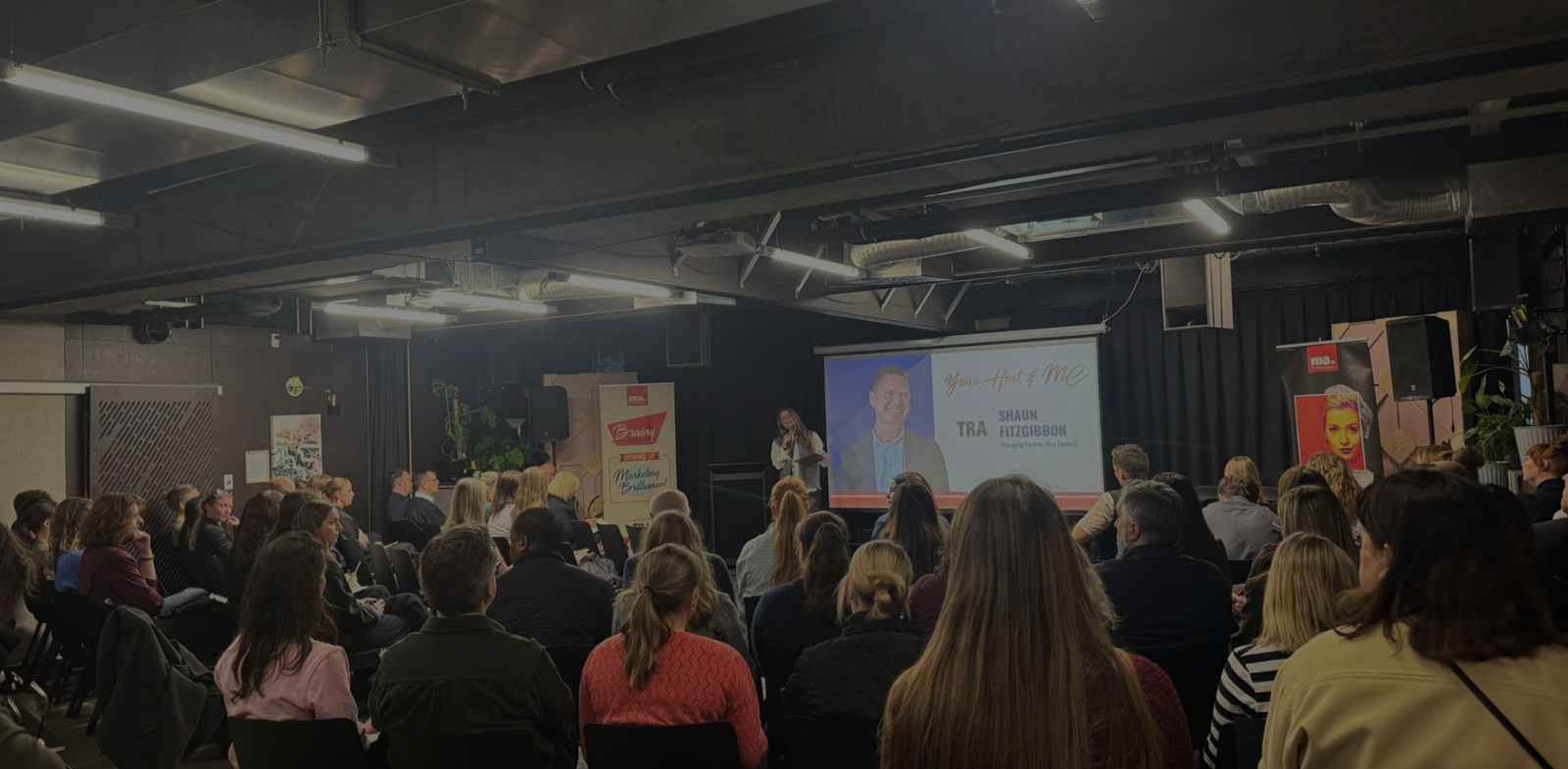
Lessons from the Sep 2026 Wellington Brainy Breakfast
In an industry increasingly obsessed with data, dashboards and demonstrating ROI, are marketers actually measuring the things that matter?
That was the central question at the Marketing Association’s Brainy Breakfast in Wellington in September 2026, where industry leaders explored how marketers can bridge the gap between campaign performance and commercial outcomes.
Hosted by TRA’s Shaun Fitzgibbon, the morning featured a keynote from Simon Bird, Strategy & Measurement Partner at Lassoo Media, followed by a star-studded panel of marketing leaders from Whittaker’s, Meridian Energy, Queen Margaret College and EECA.
The danger of measuring the wrong things
Simon Bird opened with a provocative challenge: just because something can be measured doesn’t mean it matters.
Drawing on examples ranging from weight loss to wartime plane design, Simon explored how an obsession with precision can lead organisations to optimise the wrong things.
The McNamara fallacy, for example, describes the tendency to make decisions based on what can be easily quantified while disregarding important information that cannot. Similarly, the infamous cobra bounty scheme in colonial India demonstrated how poorly designed incentives can make the very problem they aim to solve worse.
For marketers, the implications are significant.
In today’s world, we have (far) more data and increasingly sophisticated analytics, but this alone does not automatically lead to better business decisions. Optimising individual channels, campaigns or conversion metrics often improves performance on a dashboard without improving the overall health of a business.
Rather than pursuing precision for its own sake, we need to work backwards from the commercial outcomes we are trying to achieve… and then identify the information that is going to help us get there.
Effective measurement in this context requires interpreting signals from this information, understanding the relationships between these signals, and recognising the limitations of our data.
Simon argued that marketing operates within a complex system influenced by three interconnected forces:
- our own marketing activity,
- our competitors,
- wider market conditions.
We can directly control only one of these, but our measurement approach must account for these external influences before drawing conclusions about marketing effectiveness.
This may mean using imprecise data, or relying on human interpretation... but, Simon says, it is better to be approximately right than precisely wrong.
Making measurement meaningful in the real world
The subsequent panel, moderated by TRA’s Shaun Fitzgibbon, brought these ideas to life through the experiences of four marketing leaders.
Christina Mossaidis, Queen Margaret College, demonstrated the value of integrating marketing measurement with wider business objectives. Customer insights have helped inform decisions extending well beyond advertising, including investments in transport and after-school care.
For Christina, marketing’s influence is strongest when it extends beyond communications and helps shape the product and customer experience itself.
Soraya Cottin, Whittaker’s, discussed the challenges of maintaining investment in an already successful brand. While strong brand recognition can make it easier to demonstrate marketing’s historical value, it can also create pressure to reduce investment.
Her approach combines monthly brand tracking, sales performance and longer-term measures, recognising that everything from advertising to product innovation contributes to brand building.
Eugene Chetty, Meridian Energy, highlighted the importance of accounting for external market conditions. Energy prices, weather and wider industry dynamics can significantly influence customer sentiment, making it dangerous to attribute every movement in brand health to marketing activity.
Meridian uses quarterly measurement alongside longer-term commercial objectives to understand both immediate performance and its cumulative impact.
Russ Duncan, EECA, explored the particular challenges of measuring public sector marketing, where behavioural change can take years to materialise.
By using conservative modelling to estimate financial and societal returns, his team can translate long-term outcomes into a commercial language that resonates with senior decision-makers, helping get campaigns over the line.
The takeaway: Better measurement leads to better decisions
Across the keynote and panel, a consistent theme emerged: measurement should be a means to an end, not an end in itself.
More data doesn’t automatically produce better decisions. In fact, an abundance of metrics can make it harder to distinguish meaningful signals from noise.
The challenge for marketers is to move beyond isolated campaign metrics, understand the wider commercial context and communicate the value of their work in language the rest of the business understands.
Ultimately, the objective isn’t to measure everything perfectly. It’s to measure what matters, interpret it intelligently and use those insights to make better decisions. This may not be as precise, but it will be more useful.
Author: Marty Bull, Group Business Director, OMD + Member of MA’s Central Regional Advisory Group, 25th September 2026

.svg "MA-Logo (1)")