
First Published: 08 September, 2026
Marketing has always been about reaching people. But AI has fundamentally changed the journey.
Whether you're in B2B or B2C, you're now marketing to two audiences at the same time, humans and machines, and each requires a different approach.
This two-part series explores how to market successfully in an AI-dominated landscape where your audience is both human and machine.
Part 1 lays the strategic foundation. You'll discover why the traditional marketing playbook no longer works, what's changed in how people discover content, and the two-track approach every marketer needs to master right now. Part 2: "Practical GEO Tips for Marketers" puts strategy into action. You'll get specific, tactical moves, including the query fan-out technique, three technical foundations, and the tools to implement them.
Read this series if you want to:
Understand how AI search is reshaping customer discovery
Stay ahead of competitors still optimising for yesterday's algorithms
Get a concrete playbook to implement, not just theory
The Human Track: Earn Trust
People still buy from brands they trust.
In B2B, that means understanding the customer's problem, demonstrating expertise, providing proof and giving sales teams the insights they need to have meaningful conversations.
In B2C, it means relevance, authenticity, community and showing up in the moments that matter.
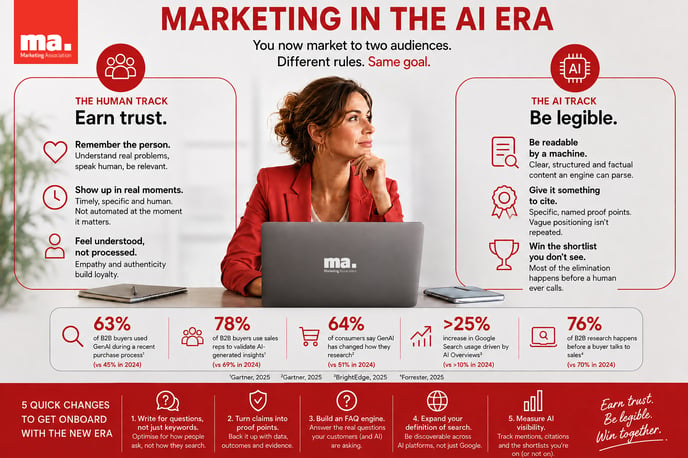
And importantly, AI isn't replacing the human relationship. Recent Gartner research shows that 78% of B2B buyers use sales representatives to validate AI-generated insights. The message is clear: buyers want to self-educate, but they still value human expertise when it matters. (Gartner, 2025)
The AI Track: Be Discoverable. Be Legible. Be Credible.
At the same time, your brand needs to be understood by the platforms increasingly influencing discovery, ChatGPT, Google AI Overviews, Gemini and AI-powered search.
The behaviour is already shifting. In 2025, 63% of B2B buyers reported using GenAI during a recent purchase, primarily to research vendors and products. (Gartner, 2025)
And in B2C, 64% of consumers say GenAI has changed how they research, including how they phrase their searches. (BrightEdge, 2025)
AI is also changing search behaviour itself. In 2025, Google usage for queries influenced by AI Overviews is reported to have increased by more than 25%, reinforcing how quickly AI is reshaping discovery. (Forrester, 2025)
So the question for marketers is changing:
From: "Can my customer find me?"
To: "Can AI understand me, trust me and recommend me?"
And this matters because AI doesn't simply rank content in the traditional sense. It needs information it can interpret, connect and confidently use.
That means clear claims, structured content, original expertise, evidence, reviews, FAQs, product information, named customers and use cases, and third-party validation. Give AI something worth citing.
5 Quick Changes You Can Make Today
1. Rewrite Your Website for Questions, Not Just Keywords
Create content around the questions your customers actually ask.
B2B: "How do I reduce downtime in an electrical asset?"
B2C: "What are the benefits of taking creatine and collagen together?"
Think conversationally. AI searches are becoming longer, more specific and more question-led.
2. Turn Vague Marketing Claims Into Proof Points
Stop using empty phrases like "Industry-leading," "Innovative" or "Best-in-class." AI can't do much with these. Replace them with specific, verifiable facts, numbers, customer outcomes, credentials and evidence.
3. Build an FAQ Engine
Your FAQ shouldn't be an afterthought. Identify the 20–30 questions your customers, prospects and sales teams hear most often and answer them clearly on your website. This is valuable for humans and machine-readable discovery. Tip: BrightEdge and SEMRush are really great platforms for AI prompt and keyword discovery.
4. Expand Your Definition of "Search"
Your brand's search presence is no longer just Google. Think broadly:
Google + ChatGPT + Gemini + YouTube + Reddit + LinkedIn + industry publications + review sites
Your website is still critical, but it shouldn't be the only place your brand exists.
5. Start Measuring AI Visibility
Add a new layer to your reporting. Don't just ask
"What keywords are we ranking for?"
Start asking: "When our customers ask AI about our category, are we mentioned?"
Track brand mentions, competitors appearing alongside you, the questions where you're recommended, citations and the sources AI relies upon.
The Big Takeaway
B2B and B2C may have different audiences, buying cycles and channels — but the fundamental shift is the same.
The brands that win in the AI era will do two things exceptionally well:
This isn't a choice between human marketing and AI marketing. It's both. On purpose.
Because increasingly, the shortlist is being created before your customer ever speaks to you. With 76% of B2B research now happening before a buyer talks to sales, the brands that are visible, credible and easy for AI to understand have a greater opportunity to make that shortlist. (Gartner, 2025)
Welcome to the new era of digital marketing.
What's Next: From Strategy to Action
You now understand the challenge: marketing to two audiences simultaneously, humans and machines. But knowledge without action is just theory. In Part 2 of this series ("Practical GEO Tips for Marketers"), we move from the why to the how. You'll get the three tactical moves that directly implement this two-track strategy.
Category


.svg "MA-Logo (1)")